The Future of Surgical Robotics: What Is Coming and What Is Hype
15 June 2026 · By Robotic.mu · Updated 5 July 2026
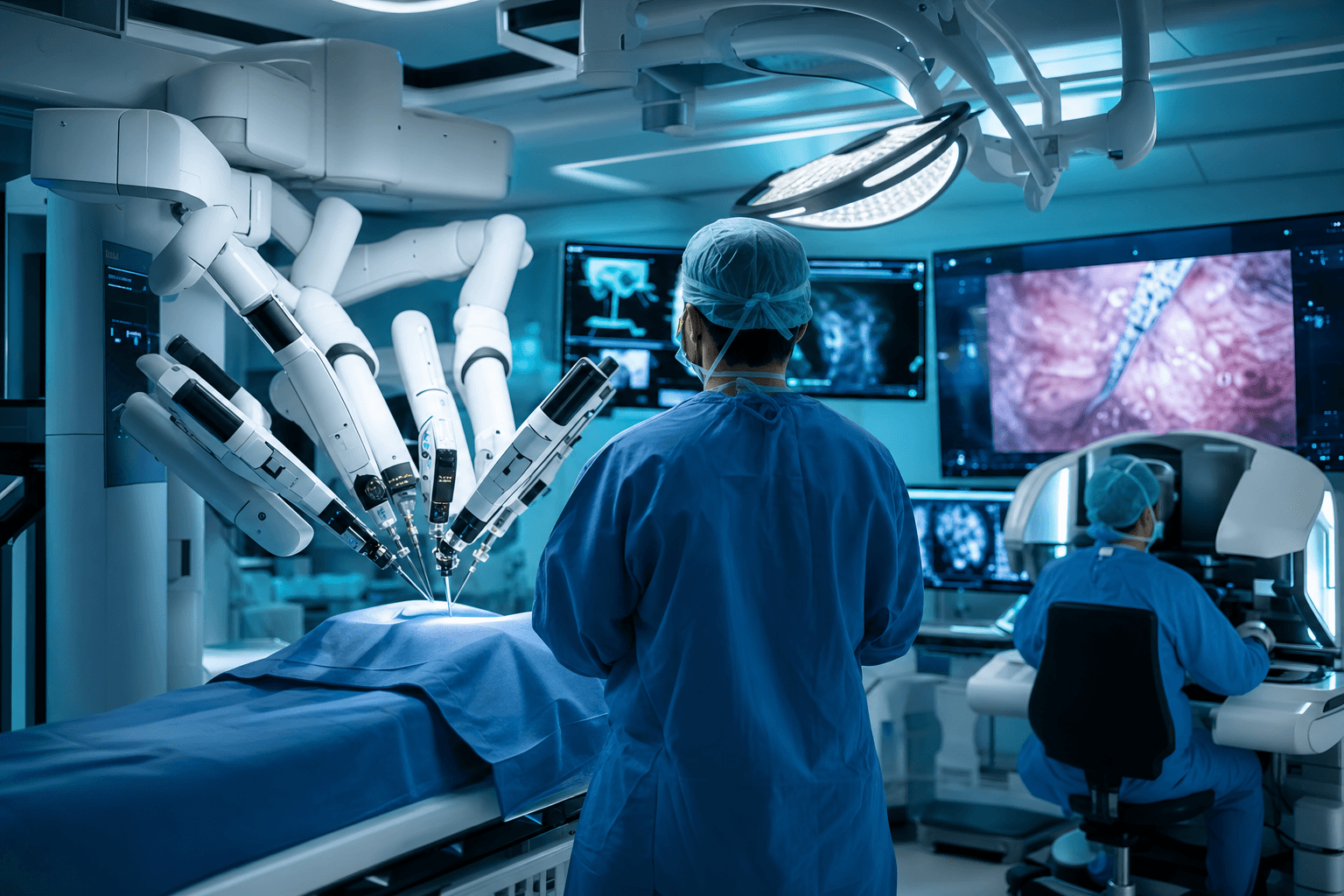
Predicting medical technology is risky: the field is littered with confident forecasts that never survived contact with regulators, budgets, or biology. Still, the direction of surgical robotics over the next decade is visible in systems already in trials and in the economics reshaping the industry. Here is a grounded tour, with the hype labelled as such.
Smaller, cheaper, everywhere
The clearest trend is not futuristic at all: cost collapse. The expiry of foundational patents has unleashed dozens of competitors across the US, Europe, India, China, and South Korea. Modular designs let hospitals start with a single arm and expand later. Instrument pricing models are being renegotiated across the industry.
This matters enormously outside wealthy health systems. The barrier that kept surgical robots out of smaller markets was never clinical, it was financial. As entry costs fall, the technology follows the path of laparoscopy in the 1990s and CT scanning before that: from flagship rarity to standard equipment. For a market like Mauritius, with a strong private healthcare sector serving both residents and a growing medical tourism ambition, that trajectory is the single most consequential development on this list.
Intelligence in the operating theatre
Artificial intelligence in surgery attracts the most headlines and deserves the most careful language. What is real and near term:
- Video analysis that recognises anatomical structures and procedural steps, flagging, for example, that a critical duct or nerve is near the active instrument.
- Augmented visualisation, overlaying preoperative scans onto the live surgical view so a surgeon can see a tumour's margins or a hidden vessel.
- Objective skills assessment, where software analyses instrument movements to give surgeons feedback once available only from a senior mentor watching over their shoulder.
- Fluorescence and advanced imaging that show blood flow and tissue health in real time, already in routine use on current platforms.
What remains distant: autonomous surgery on humans. Research systems have performed impressive supervised tasks, such as suturing bowel in animal studies, but the regulatory, ethical, and liability path to unsupervised autonomy in people is long by design. Expect automation of narrow subtasks under direct surgeon supervision, perhaps camera positioning or knot tying, well before anything resembling a robot surgeon. Treat any claim otherwise as marketing.
Telesurgery grows up
Remote surgery was the original military dream behind the field, and it is quietly becoming practical. Demonstrations in China and elsewhere have shown surgeons operating on patients hundreds or thousands of kilometres away over high speed, low latency networks. The near term value is not exotic: it is mentoring. An expert in Paris or Mumbai guiding, and eventually assisting, a local team through a complex case could compress training timelines dramatically.
For island nations, the long term implications are worth pondering. A reliable telesurgery link could one day let Mauritian patients access rare subspecialty expertise without flying anywhere. The engineering is maturing faster than the legal frameworks: questions of licensing, liability, and network failure protocols remain genuinely unsolved.
New shapes: beyond the four armed cart
The familiar multi-arm robot is only one body plan. In development or early use are single port systems that enter through one small incision, flexible robots that navigate natural passages such as the airways and colon to treat disease with no external cut at all, microrobots and steerable catheters for blood vessels and the brain, and specialised orthopaedic and spine platforms that machine bone with sub-millimetre accuracy. Surgery is fragmenting into an ecosystem of task specific robots rather than one universal machine.
How to read the next decade
A few honest calibrations. Adoption will be uneven: expect world class robotic programmes and underfunded basic surgery to coexist, sometimes in the same country. Evidence will lag enthusiasm, so insist on data per procedure rather than per brand. And the surgeon will remain the decisive variable; every technology above amplifies human judgement rather than replacing it.
For readers in Mauritius who want to track which of these capabilities actually reach the region, following dedicated regional health technology coverage such as medtech.mu is more useful than global press releases, because the gap between announced and available is where patients get misled.
And the constant amid all this change: whether any procedure, robotic or otherwise, is right for you is a decision to make with a qualified clinician who knows your history, never on the strength of technology trends alone.
The technology behind modern operating rooms, explained. Explore the wider Medtech medical-technology network.