Robotic Surgery vs Traditional Laparoscopy: What the Differences Really Mean
11 June 2026 · By Robotic.mu · Updated 5 July 2026
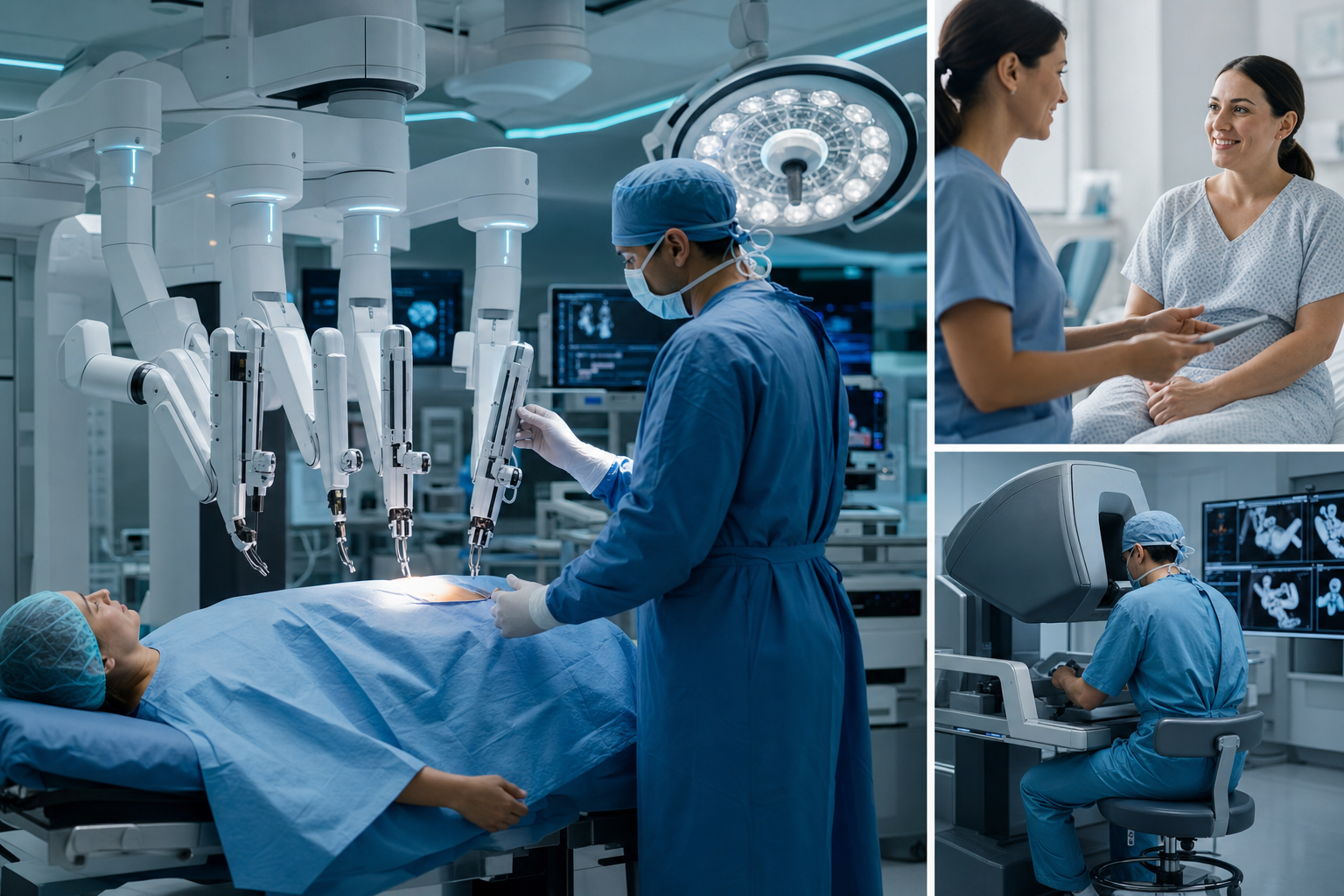
Patients are often told they will have "keyhole surgery" without much detail about which kind. Yet there are two distinct families of minimally invasive surgery: conventional laparoscopy, performed with long rigid instruments held directly by the surgeon, and robot assisted surgery, where those instruments are mounted on robotic arms controlled from a console. Understanding the difference helps you ask better questions.
Where the two approaches are identical
Start with what does not change. Both approaches use small incisions instead of one large one. Both inflate the abdomen with carbon dioxide to create working space. Both require a general anaesthetic, a trained surgical team, and an operating theatre. Both dramatically reduce wound size, blood loss, and hospital stay compared with traditional open surgery. If your comparison point is open surgery, either minimally invasive option is usually the bigger win.
Precision and ergonomics: the robot's home ground
The genuine differences appear at the instrument tip and at the surgeon's body.
Laparoscopic instruments are straight sticks. They pivot at the abdominal wall, which reverses the surgeon's hand movements and limits angles of approach. Robotic instruments have articulated wrists at the tip, restoring the natural range of motion a surgeon has in open surgery, and the console eliminates the mirror image problem entirely.
Ergonomics matter more than patients realise. Long laparoscopic cases require surgeons to stand in awkward postures for hours, and surgeon fatigue is a recognised issue in the profession. At a robotic console the surgeon sits with forearms supported. A fresher surgeon at hour four of a complex pelvic dissection is a real, if hard to measure, advantage.
The robot also filters tremor and offers stable, magnified 3D vision. For fine suturing deep in the pelvis, such as rejoining the bladder and urethra after prostate removal, most surgeons find the robotic platform meaningfully easier.
Where laparoscopy holds its own
Honesty requires the other side of the ledger:
- Cost: robotic systems carry high purchase, maintenance, and per-case instrument costs. Laparoscopy is far cheaper, which matters for patients paying privately and for health systems with tight budgets, a very real consideration in Mauritius.
- Setup time: docking the robot adds time to each case, though experienced teams shrink this gap considerably.
- Tactile feedback: laparoscopic surgeons feel tissue resistance through their instruments. Most current robotic systems provide limited or no haptic feedback, and surgeons compensate using visual cues, a skill that takes training.
- Evidence parity: for several common procedures, including many gallbladder removals and straightforward hernia repairs, high quality studies show broadly similar outcomes between the two approaches when performed by experienced surgeons.
Procedures where the robot tends to earn its cost
The robot's advantages compound in narrow, deep spaces requiring fine reconstruction. Specialties where robot assisted surgery has become a dominant or strongly favoured approach in well resourced health systems include radical prostatectomy, complex hysterectomy and endometriosis surgery, rectal cancer resection, and some kidney, bladder, and thoracic procedures. In these operations, surgeons frequently report better visualisation and easier suturing, and studies commonly show lower blood loss and shorter hospital stays, though results vary by procedure and team.
For simpler operations in accessible locations, the added cost of the robot is harder to justify, and an excellent laparoscopic surgeon delivers excellent results.
The variable that outweighs the technology
Here is the point most marketing brochures skip: the surgeon's experience with the specific approach matters more than the approach itself. A laparoscopic expert with a thousand cases will generally serve you better than a surgeon early in their robotic learning curve, and the reverse is equally true.
So when weighing options, whether locally or when considering treatment abroad as many Mauritian patients do for specialised procedures, ask about the surgeon's personal volume with the proposed technique, their conversion rate to open surgery, and why they recommend one approach over the other for your specific anatomy and diagnosis. A confident specialist will welcome those questions.
Finally, remember that no comparison article can account for your medical history, your diagnosis, or your priorities. Use this as a foundation for a conversation with a qualified surgeon, not as a substitute for one.
The technology behind modern operating rooms, explained. Explore the wider Medtech medical-technology network.